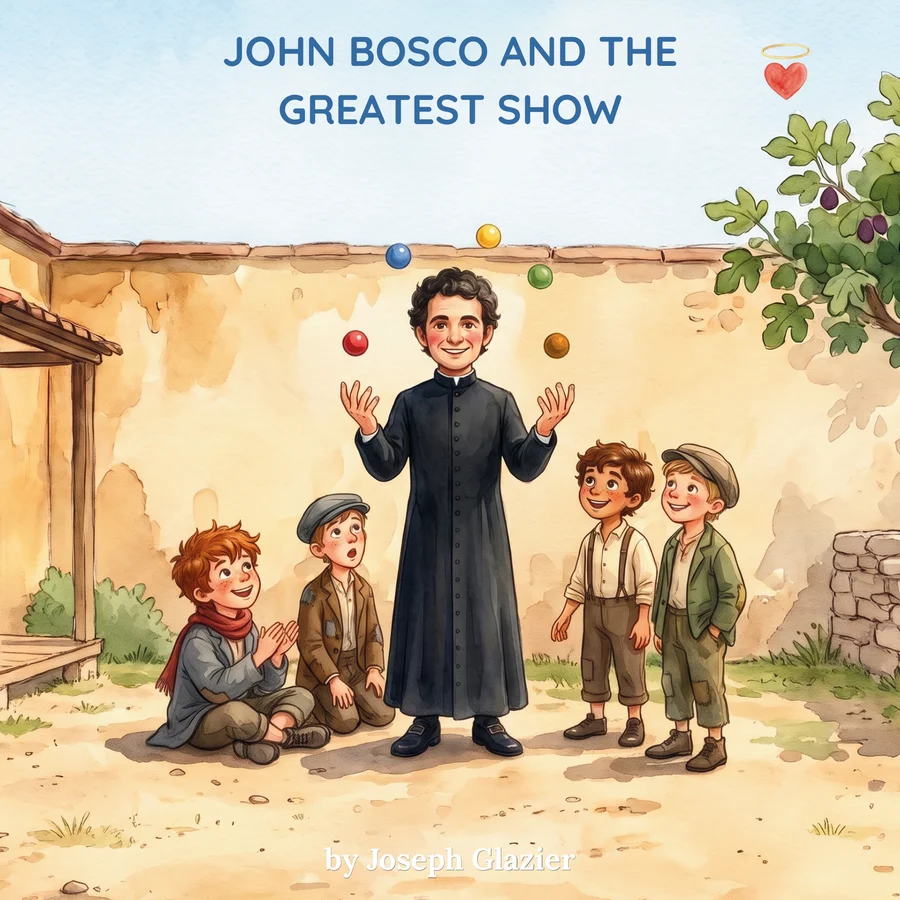
1. Read his story
John Bosco was born in 1815 in Becchi, a farming hamlet in the hills near Turin, in northern Italy. His father died when John was two, and his mother, Margaret, raised her boys with faith and love. When he was nine, John had a dream that he never forgot: he was to win wild, unhappy boys for God, not with fists but with kindness. He became a priest in 1841, and in the city of Turin he found boys with no home and no one to care for them. He gave them the Oratory, a place where they could eat, learn to read, learn a trade, pray and play. The priests and brothers who came to help him became the Salesians, and today they care for young people all over the world.
Our picture book tells his story gently for reading aloud, and ends with a simple prayer and three small ways to share joy and kindness this week. See the book.
2. Put on the greatest show
When traveling acrobats came to the fair, young John watched them carefully, then practiced until he could juggle, tumble and do tricks himself. He put on shows for the children of his village, and the price of a ticket was a prayer: everyone prayed with him before the show began and again at the end, and he told them what he had heard at church.
Put on a family show the same way. Everyone does one thing: a joke, a song, a dance, a puppet or a trick, and little ones can perform with a grown-up. Open and close the show with a prayer together, the price of a ticket.
For a class or a parish group, our free Greatest Show pack (PDF, opens in a new tab) has show tickets to color, each one marked “Price: one prayer,” a leader's plan for a class show where every child has a part, and a take-home page about answering with kindness.

3. Learn a little trick
Because of his juggling and tricks, Don Bosco is honored as a patron of magicians, and Catholic magicians in many countries put on free shows for children around his feast day.
Learn a simple trick together. To start juggling, roll a pair of socks into a ball and toss it from one hand to the other in a gentle arc, about as high as your eyes. When that's easy, try two. Or learn a joke or a riddle instead: the book's third challenge is to use it to make someone smile.
4. Run and jump and shout
Don Bosco wanted his boys to have plenty of room to run, play and make noise, and he joined in their games. He is remembered for telling them, “Run and jump and shout, but do not sin!”
Play outside together, or in a gym: tag, relay races, hopscotch or a game everyone can join. Choose games where nobody sits out for long, the way Don Bosco made room for every boy. Finish by thanking God for games and friends.
5. Win with kindness, not fists
In his dream, nine-year-old John ran at a crowd of fighting boys with his fists. But in the book, a shining man tells him gently, “Not with fists, John — with kindness and love you will win them.” It became the way he treated every child.
Talk with your children about what to do when someone makes them cross. Practice together: stop, take a deep breath, and say something kind, or walk away. Try the second challenge from the end of the book:
- Whenever someone makes you cross, don't hit, push, or shout back. Take a deep breath and answer with love and kindness, just as John learned in his dream. And if someone keeps being unkind, tell a grown-up.
6. Welcome a new friend
The story told of how Don Bosco's work began is of a lonely boy named Bartholomew, who slipped into a church in Turin on December 8, 1841, and was being chased out. Don Bosco called him back, asked his name, and, so the story goes, asked, “Can you whistle?” Bartholomew laughed, and a friendship began. The next Sunday he brought his friends.
Don Bosco always began with a child's name. Try the first challenge from the book:
- Learn the name of a new child at school or church, and ask them to play with you.
7. Draw Grigio
Don Bosco told of a big gray dog that appeared many times when he had to walk home through dangerous streets at night. It walked beside him all the way to his door, then quietly slipped away. He called the dog Grigio, which means “gray,” and believed God had sent him.
Children love this story. Let them draw Grigio walking beside Don Bosco under a street lamp, and talk about the people God gives us to keep us safe: parents, teachers and our guardian angels.
8. Pray together
End the day with the prayer from the book:
Dear God,
Thank you for games and laughter and friends.
Fill my heart with joy,
and when I feel angry, help me to win others,
not with fists, but with kindness and love,
the way Saint John Bosco did.
Amen.
For a printable page with this prayer and the three challenges, with tick boxes for the week, download Saint John Bosco’s Be a Little Saint page (PDF, 1 page, opens in a new tab), or all seven saints together.
In the classroom or parish
- A read-aloud lesson: our free one-page teaching guide has questions for before, during and after reading the book, words to explain, and a note for the leader.
- A Catholic Schools Week show: Don Bosco is a patron saint of schoolchildren, and his feast falls during Catholic Schools Week, so it's a natural day for a class show. The Greatest Show pack has a 40-minute plan where every child has a part, and the price of every ticket is a prayer.
- Thank the cooks: Don Bosco's mother came to Turin to cook and care for his boys, who loved her and called her Mamma Margherita. Make thank-you cards for the people who cook in your school or parish kitchen.
- A saint who was a schoolboy: Dominic Savio was one of the boys at the Oratory, and he became a saint too. Don Bosco wrote his life story. Tell the children about a schoolboy who became a saint by being cheerful, kind and doing his everyday work well.
- A new-friend game: pair the children up to learn three things about each other, then introduce their partner to the group.
Don Bosco's way with children
For catechists and teachers, Don Bosco's method is worth knowing. He said his way of teaching rested on three things: reason, religion and loving kindness. He explained rules instead of only enforcing them, made faith part of everyday life, and above all made sure each child knew they were loved. He was there in the playground as well as the classroom, and he believed that prevention was better than punishment.
More ideas for catechists and teachers are on our parishes and schools page.