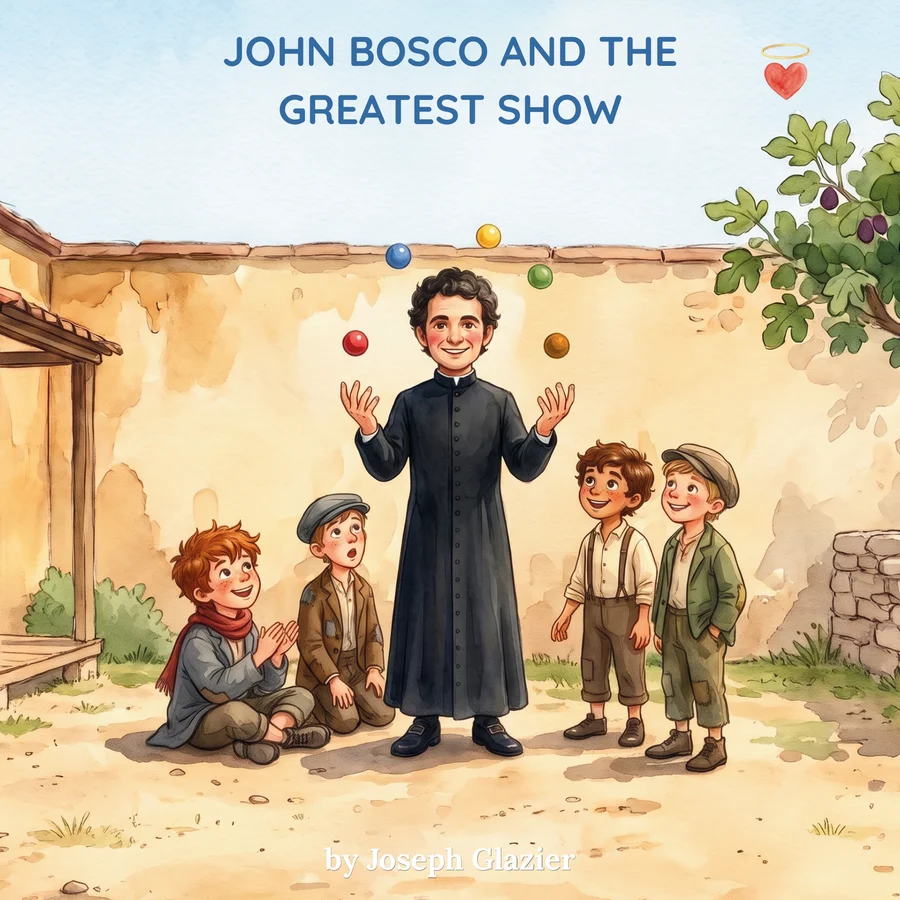
Long ago, a poor farm boy learned to juggle and tumble — and used the greatest show in the village to lead other children straight to God.
Meet Saint John Bosco — the joyful priest who filled a lonely city with laughter, made a home for boys who had no one to care for them, and won every heart not with fear but with kindness. His story gently shows little hearts that joy and gentleness are how we share God's love, and that no one is ever too small or too forgotten to be loved.
As an Amazon Associate I earn from qualifying purchases.
Ages
4 to 9
Feast day
January 31
Formats
Full-color paperback, 8.5 × 8.5 inches, and Kindle
ISBN
978-1-7647505-6-1 (paperback)
“I write these books so children can meet the saints early, as real heroes with big hearts, and keep them as friends for life. A saint loved at five can still be a friend at fifty.”
Joseph Glazier, author of Little Saints, Big Hearts
The story, scene by scene
Here is the whole story as the book tells it, in ten short scenes, with a line from each page in the book's own words. Four of the pages are shown below, so you can see how it reads and looks before you buy.
1 A poor farm boy
In the green hills of Italy lives John Bosco. His father died when he was very small, and his good mother, Margaret, raises him with all her love. John is clever and full of fun, and he makes the other children laugh.
Wherever he went, he made the other children laugh.
2 The dream
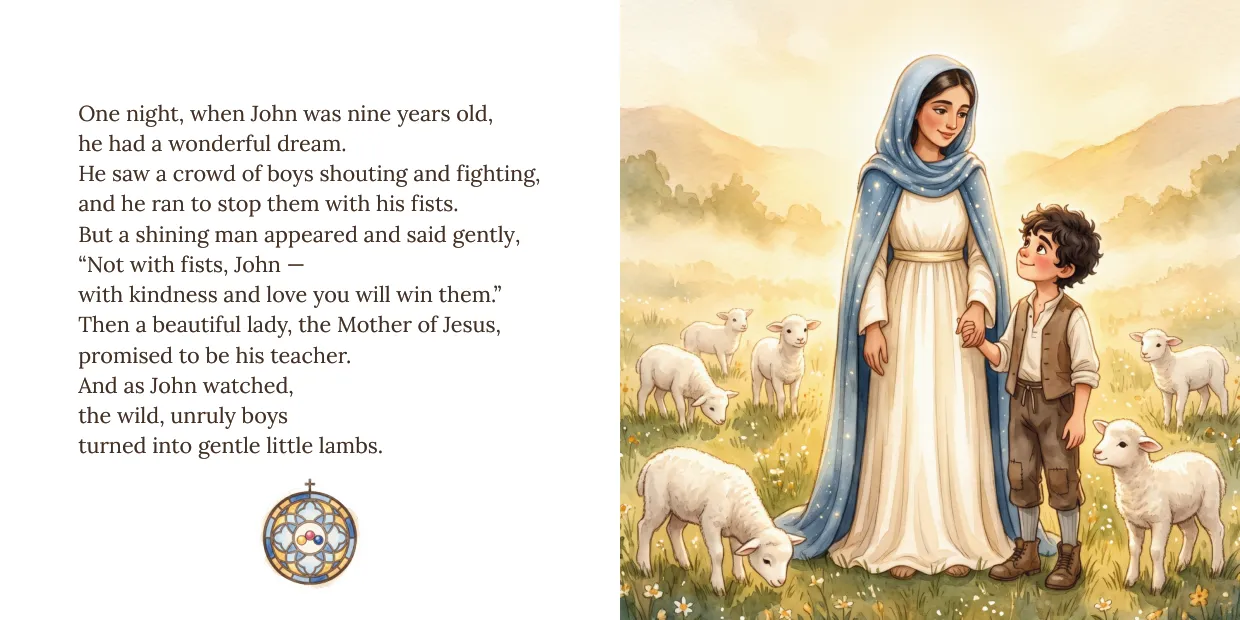
At nine, John dreams of boys shouting and fighting, and he runs at them with his fists, until a shining man stops him, and the Mother of Jesus promises to be his teacher. The wild boys turn into gentle lambs.
“Not with fists, John — with kindness and love you will win them.”
Two pages from the book: the words on the left, the picture on the right. Tap to see it larger.
3 Learning the tricks
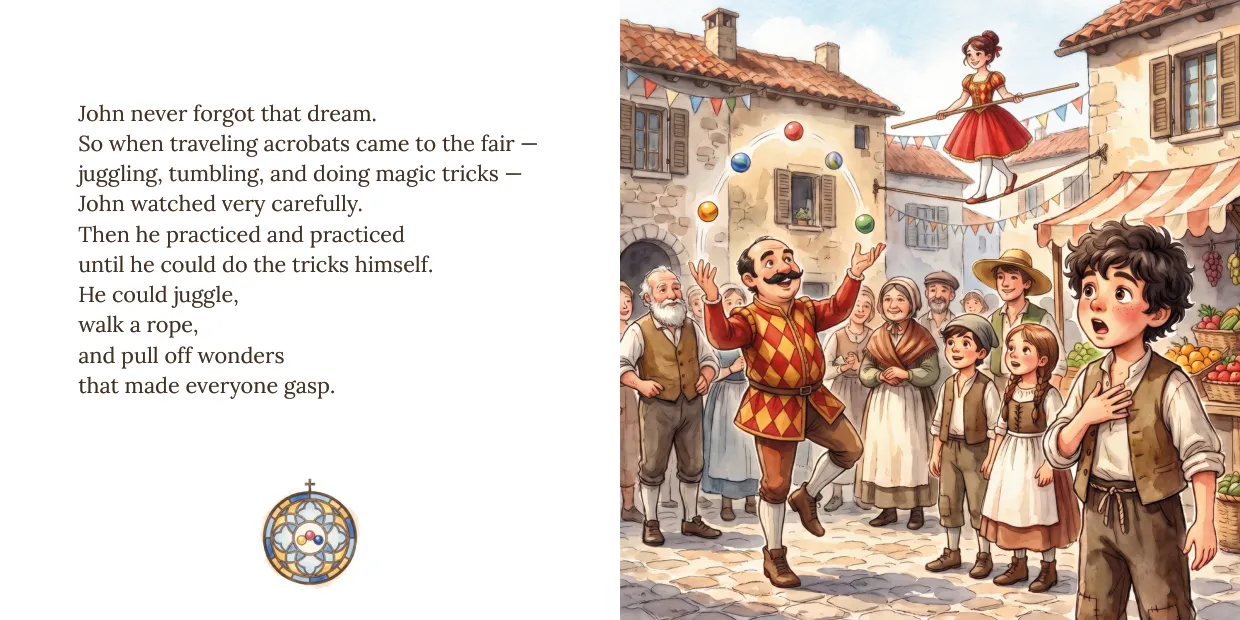
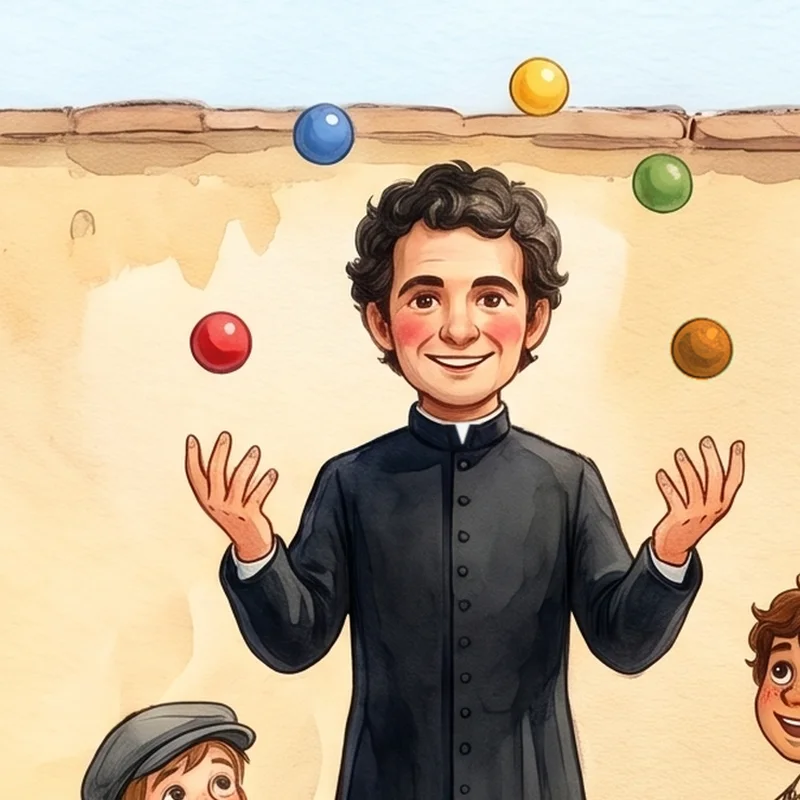
When acrobats come to the fair, John watches carefully, then practices and practices until he can juggle, walk a rope and pull off wonders that make everyone gasp.
Then he practiced and practiced until he could do the tricks himself.
Two pages from the book: the words on the left, the picture on the right. Tap to see it larger.
4 The greatest show
Soon John puts on the greatest show the village has ever seen, with one funny rule: the price of a ticket is to pray. He leads the children in prayer before every show and again at the end.
There was one funny rule: the price of a ticket was to pray.
5 Don Bosco
John grows up longing to help children know how much God loves them. He studies hard and becomes a priest, and everyone calls him Don Bosco.
From then on, everyone called him by a special name: Don Bosco.
6 Boys with no one
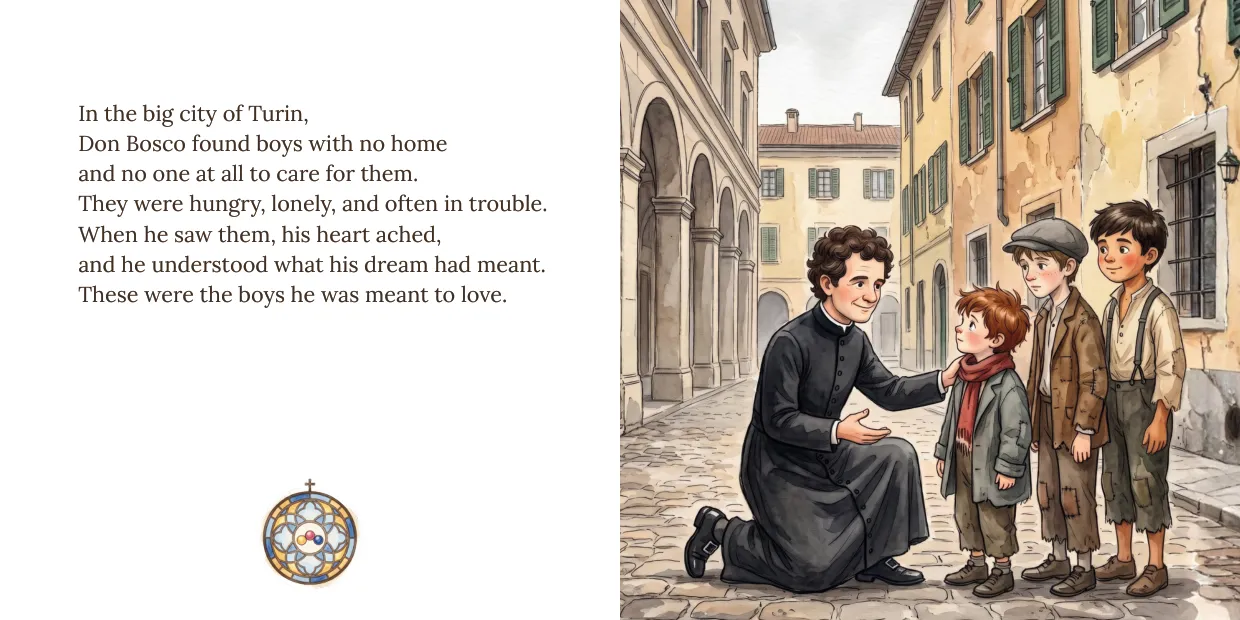
In the big city of Turin, Don Bosco finds boys with no home and no one to care for them, hungry, lonely and often in trouble. His heart aches, and he understands his dream at last.
These were the boys he was meant to love.
Two pages from the book: the words on the left, the picture on the right. Tap to see it larger.
7 The Oratory
Don Bosco makes them a home, the Oratory, where they can eat, learn to read and learn a trade, and best of all play. His own mother comes to cook and care for them.
“Run and jump and shout,” Don Bosco told them, “but do not sin!”
8 Grigio
The streets can be dangerous at night, but again and again a big gray dog appears and walks Don Bosco safely home, then slips away. He names him Grigio, and always believes God sent him.
Don Bosco named him Grigio, which means “gray.”
9 Kindness, not fear
Don Bosco never rules his boys with fear. He plays with them, does tricks, forgives them and wins their hearts with gentleness. The helpers who join him become the Salesians, who care for children all over the world today.
He played with them, did tricks for them, forgave them.
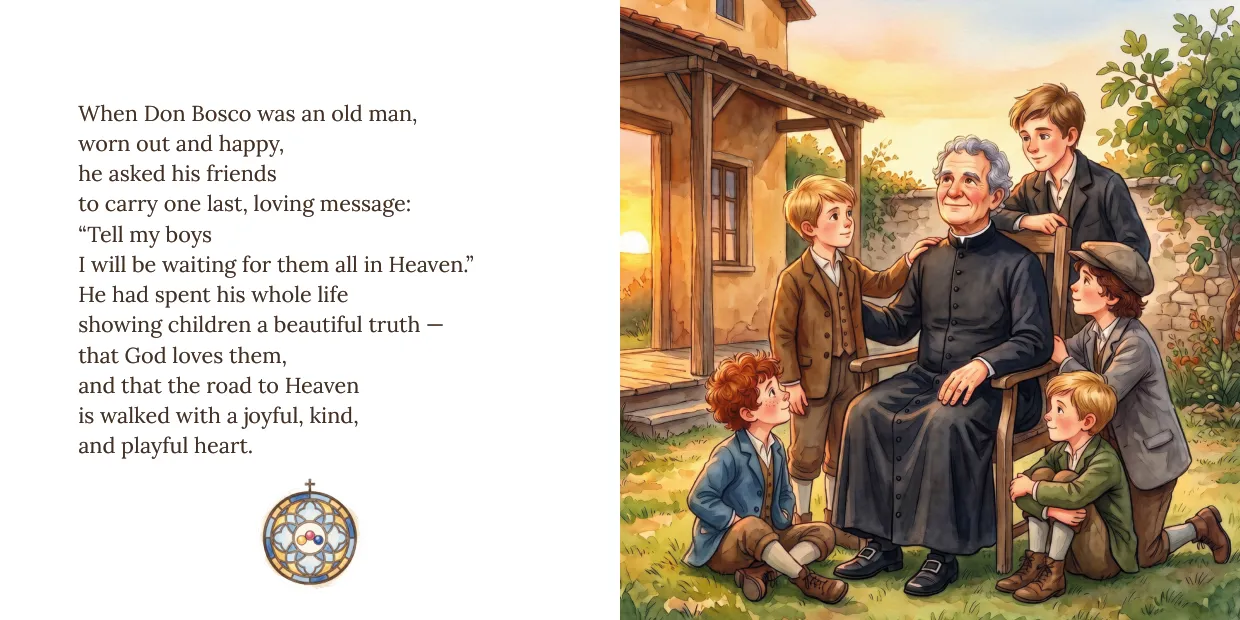
10 A last message
As an old man, worn out and happy, he sends his boys one last loving message.
“Tell my boys I will be waiting for them all in Heaven.”
Two pages from the book: the words on the left, the picture on the right. Tap to see it larger.
What it teaches: joy and befriending children
Joy, and winning others with kindness instead of fists. Children meet a saint who juggled, played and laughed, and who showed that the road to heaven is walked with a joyful, kind and playful heart. The book gives them something to do when they're angry, take a deep breath and answer with kindness, and always adds: if someone keeps being unkind, tell a grown-up.
The real Saint John Bosco
John Bosco was born in 1815 near Turin, in northern Italy; his father died when he was two, and his mother, Margaret, raised her boys with faith and love. The dream he had at nine stayed with him all his life. He became a priest in 1841, and in Turin he gave boys with no home the Oratory, a place to eat, learn, pray and play. The priests and brothers who came to help became the Salesians. The gray dog Grigio comes from Don Bosco's own account. He died in 1888 and was declared a saint in 1934. He is a patron saint of young people, students and magicians, and his feast day, January 31, always falls during Catholic Schools Week in the United States.
Is it right for my child?
About 580 words, ten short illustrated scenes: about ten minutes to read aloud, for ages 4 to 9. The book says gently that John's father died when he was small. A child who is being hurt could hear “not with fists” as “put up with it,” so the book's challenge always ends: tell a grown-up. If a child asks why the boys in Turin had no home, you can say their families were far away or had died, and Don Bosco gave them a family again.
At the end of the book
Every story ends with a page about the saint for grown-ups, a simple prayer to say together, and three small ways to follow John Bosco this week.
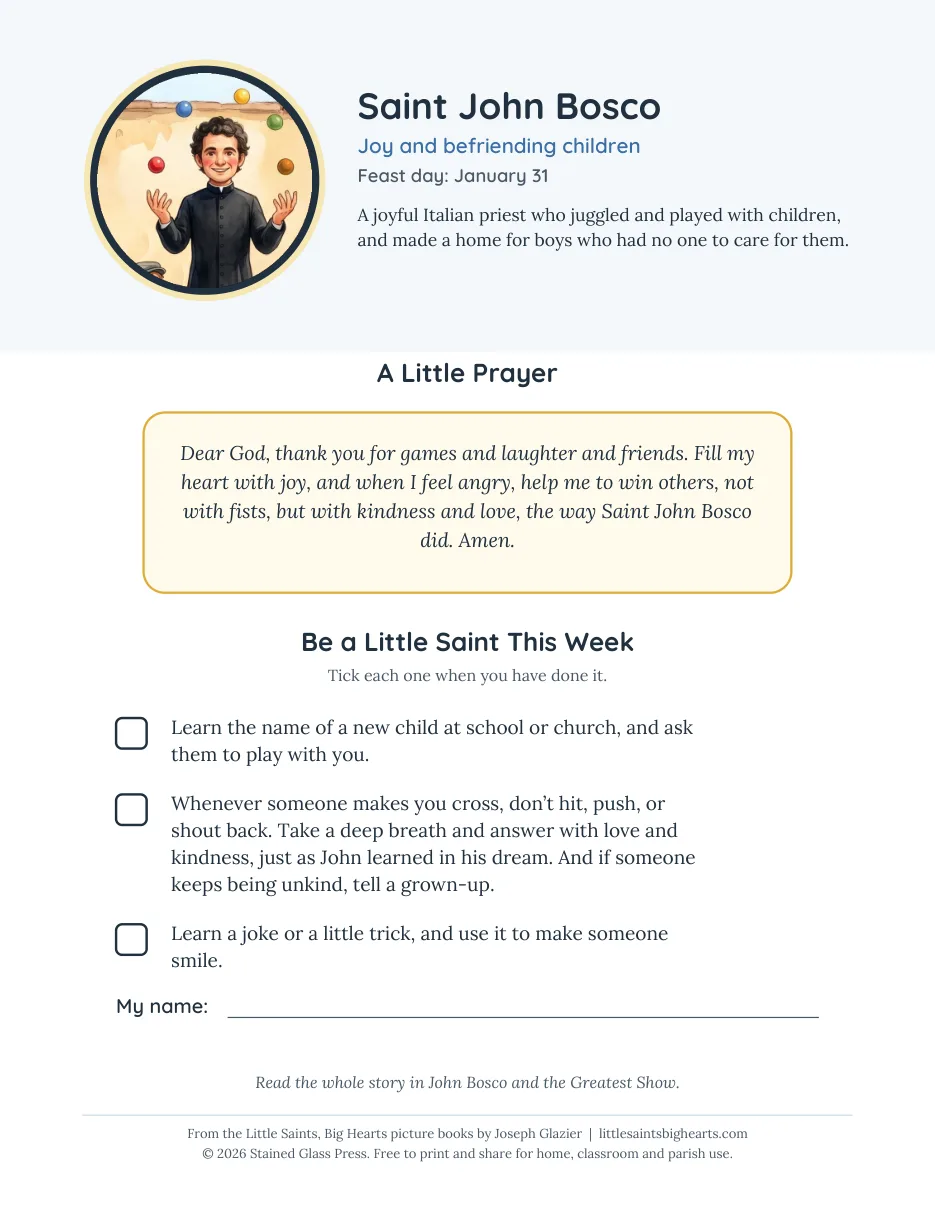
Dear God, thank you for games and laughter and friends. Fill my heart with joy, and when I feel angry, help me to win others, not with fists, but with kindness and love, the way Saint John Bosco did. Amen.
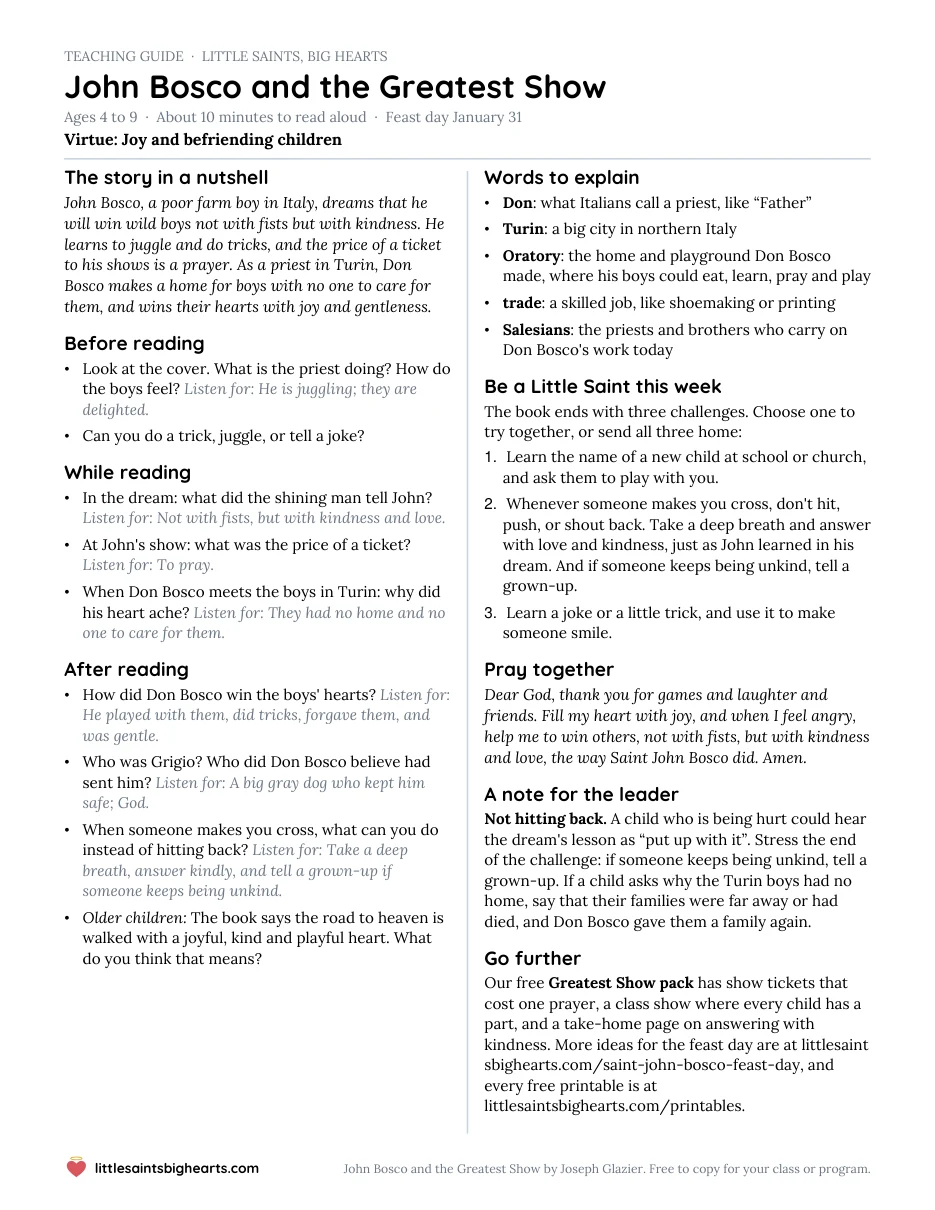
Be a Little Saint this week
Learn the name of a new child at school or church, and ask them to play with you.
Whenever someone makes you cross, don’t hit, push, or shout back. Take a deep breath and answer with love and kindness, just as John learned in his dream. And if someone keeps being unkind, tell a grown-up.
Learn a joke or a little trick, and use it to make someone smile.